
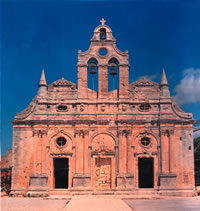
The Arkadi Monastery is located 23 km from Rethymno, at an altitude of 500 metres.  It was founded either in the second Byzantine period or in the early years of Venetian rule. At the end of the 16th century, it was radically renovated and the current Baroque-style church was built, dedicated to the Transfiguration of the Saviour and to Saints Constantine and Helen. During that period, the monastery flourished spiritually (with a manuscript copying workshop, a school, and a library). Under Turkish rule, it was looted, but it quickly recovered and became the most important monastery in Crete.
The most significant event in its history is the Holocaust of Arkadi (8–9 November 1866), during the Great Cretan Revolution (1866–1869). Since then, the monastery has continued its mission. It has been declared a European monument of Freedom and Culture. Its Ecclesiastical Museum (inaugurated in 2012 by Ecumenical Patriarch Bartholomew) houses relics, banners, icons, gold-embroidered vestments, manuscript codices, and weapons.
The Arsani Monastery is located 12 km east of Rethymno. It was founded around 1550–1600. The first katholikon (main church) was inaugurated in 1600, and in 1654 the monastery became stavropegic. In 1646, it suffered damage from a Turkish raid but was quickly restored. At the beginning of the 19th century, it faced financial difficulties, yet it still operated a primary school. During the revolution of 1897–1898, the abbot Gabriel Klados was killed heroically (the “holocaust” of Arsani).
The current church was built in 1888. The icons on the iconostasis come from the monk Artemios and his entourage from Mount Athos (1922), while the frescoes are by Georgios Christidis (1987–1990). 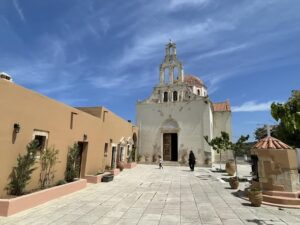 The monastery was dissolved in 1900 but re-established in 1903. It contributed financially to the construction of gymnasiums in Rethymno, supported the National Resistance, and its monk Damianos Kallergis was executed by the Germans in 1941. It operates an Ecclesiastical Museum (since 1971) and a Conference Centre.
The monastery is located 20 km from Rethymno, near the village of Roustika. It is dedicated to the Prophet Elijah (the church is a three-aisled basilica, also dedicated to the Holy Trinity and the Holy Belt). It has existed since the mid-16th or early 17th century (the earliest documents date from 1587). It is linked to the Vlastos family.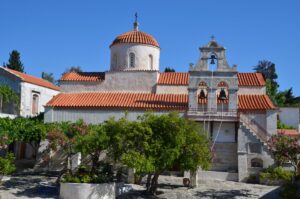
Notable features of the monastery include:
A Venetian bell tower (one of only two surviving in Crete, along with that of Arkadi)
Old bells (1565, 1634, 1636)
Wood-carved iconostasis, ambo, and throne (1844–1849) by Aetos Katzourakis
Frescoes (1905) and portable icons (18th–19th centuries)
Holy relics of saints, early printed books, and a handwritten journal (from 1620)
The monastery became stavropegic in 1713, 1778, and 1797 (with a sigillium by Patriarch Gregory V). It possessed dependencies and grazing lands. It was destroyed by the Turks in 1823. The current church was built in 1831 and inaugurated in 1832.
Its participation in national struggles was significant: supplying revolutionaries (1821), treating the wounded (1866), serving as a hospital, hosting a meeting of the Revolutionary Committee, and supporting the 1896 Revolution. During the Occupation, it safeguarded the Historical Archive of Crete. It also contributed greatly to education (schools, funding, a girls’ school).